
Consumo Justo timeline · Pamplona, Dax and Riga in one report · June – August 2026
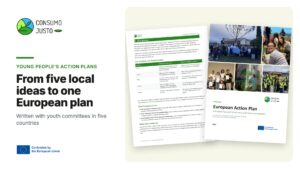
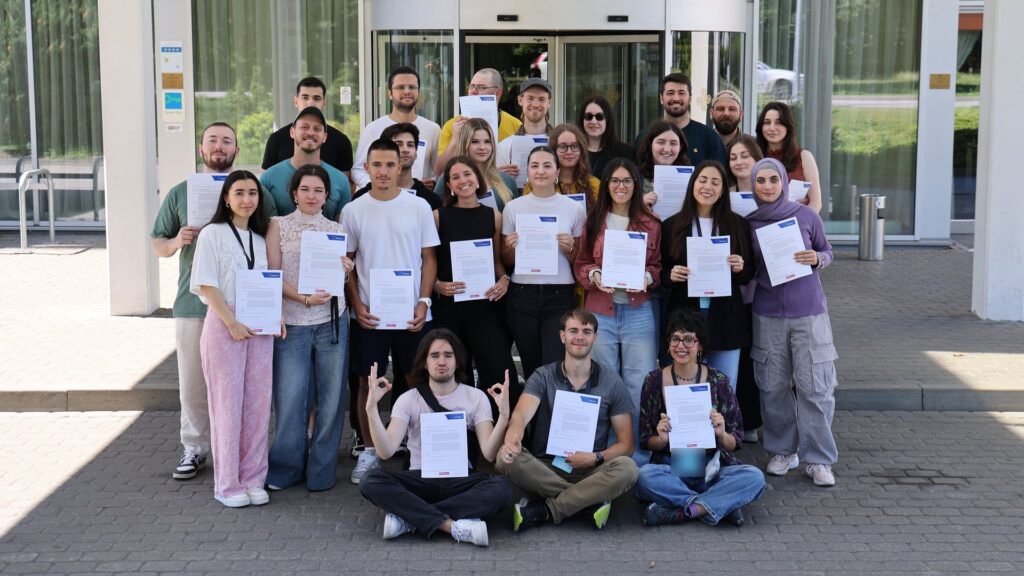
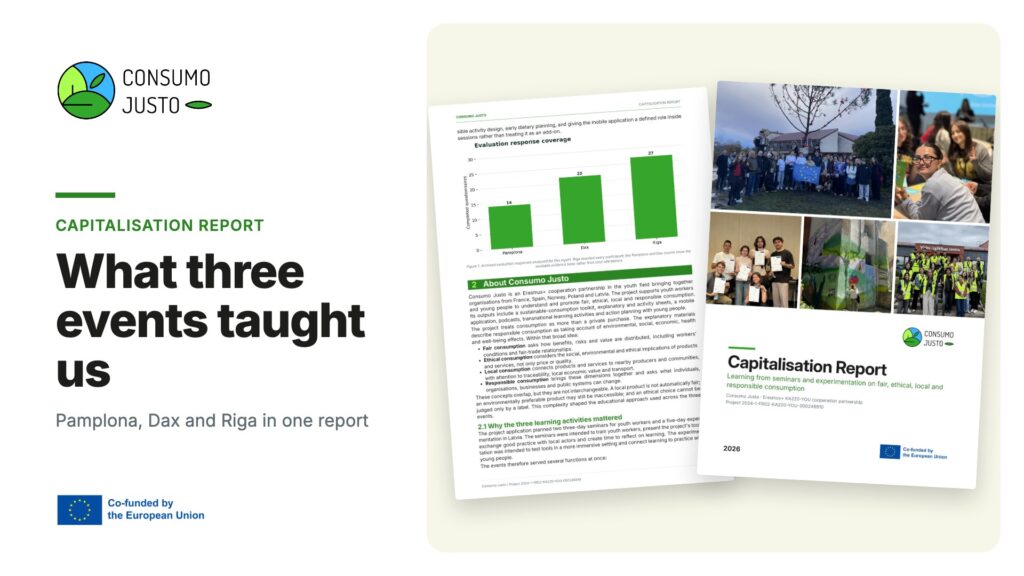
Between May 2025 and June 2026 the Erasmus+ project Consumo Justo brought youth workers and young people from five countries together three times: for a seminar in Pamplona, a seminar in Dax and a five-day training in Riga. All three were about fair, ethical and local consumption. Writing down what the events taught the partnership was our task. The result is the Consumo Justo Capitalisation Report.
“Capitalisation” is a word from European projects. It means turning experience into knowledge that someone else can reuse. A satisfaction survey asks whether people liked an activity. This report also asks what they actually did, why it worked in that place and what another youth worker would need in order to repeat it.
What it is based on
The report draws on the hosts’ reports, the programmes and 63 evaluation forms: 14 from Pamplona, 22 from Dax and 27 from Riga. In Riga every participant answered. We presented the template to the partners in Warsaw in June 2026, shared a first version in July and revised it with their comments over the summer. The final English edition has 30 pages.
Five things we learned
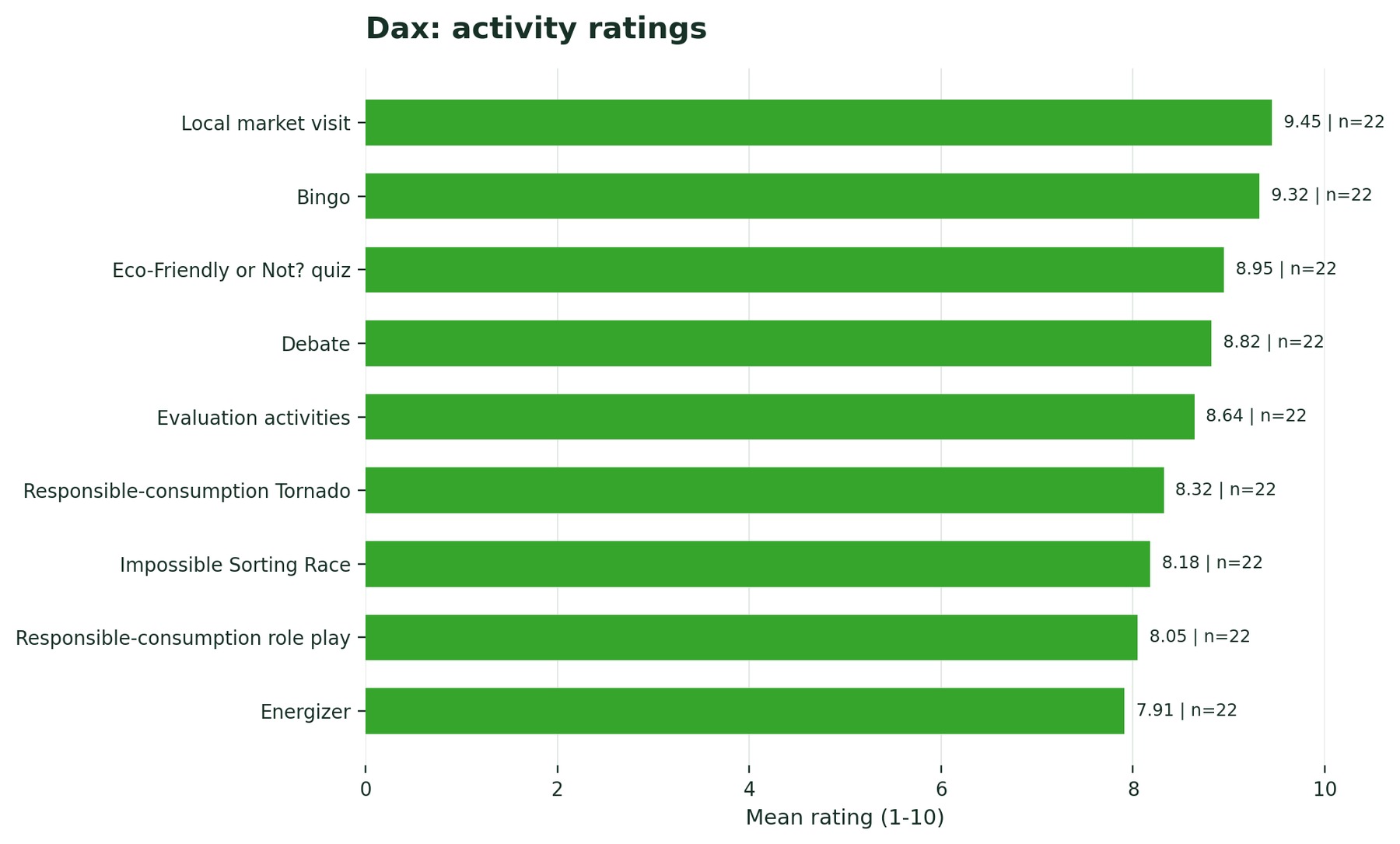
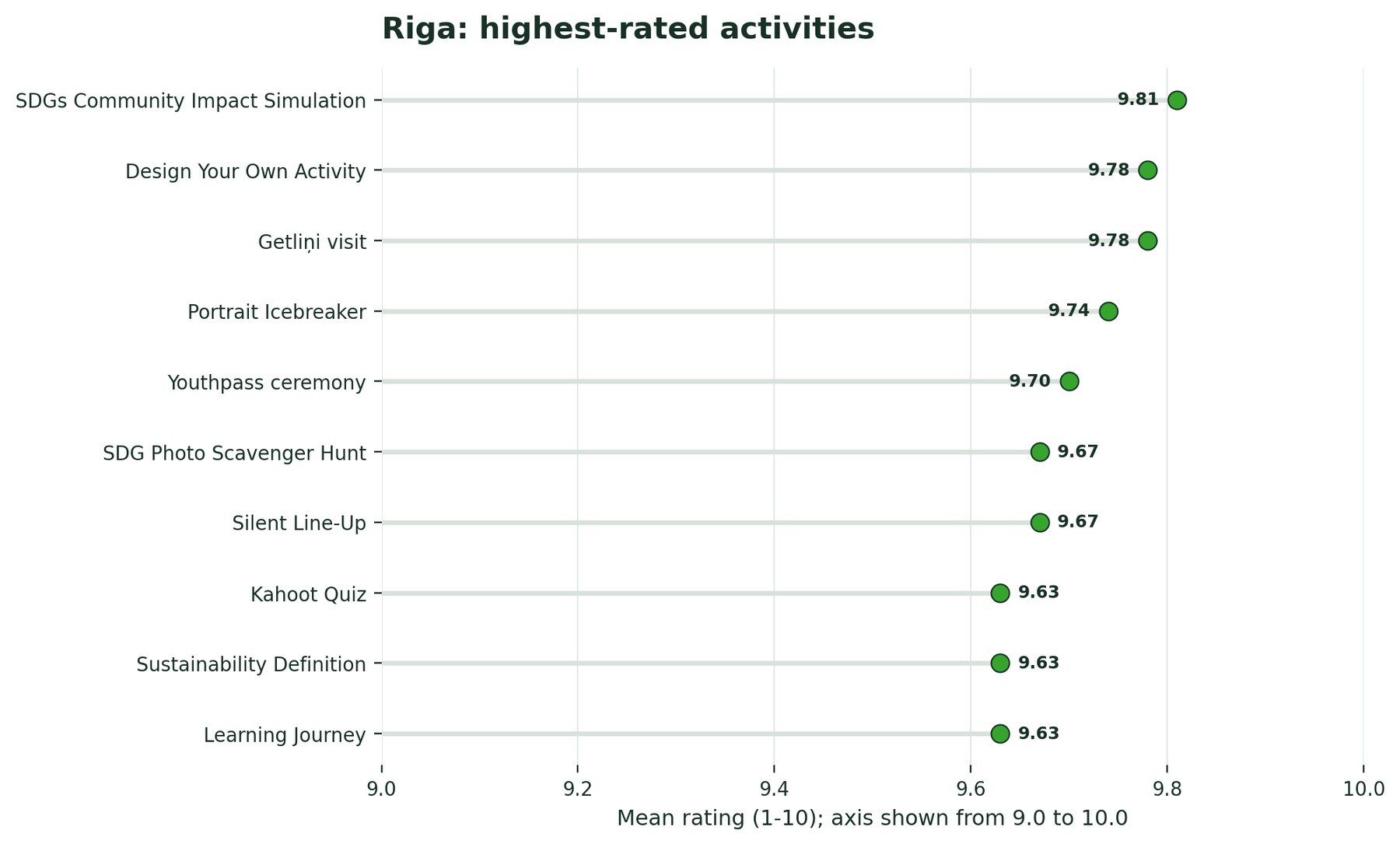
Going out teaches more than staying in. The best-rated activity in Dax was the Saturday market, with 9.45 out of 10. In Riga the visit to the Getliņi waste management site scored 9.78, and 11 of 27 participants called it the most useful part of the week.
An object is a good way into a system. Chocolate, shoes, wool, a shopping basket, a potato: each gave a group something concrete to look at. The learning came from the questions asked afterwards. Who made it, who earned what, and who can afford the alternative?
Games need a frame. Debates, quizzes and role play all scored well. Participants still asked for more background information and more time to discuss. The pattern that worked was a short input, then the activity, then a proper debrief.
Mixed groups compare, and that is useful. A choice that is easy in one country can be expensive or unavailable in another. In mixed groups participants ran into those differences themselves, in price, in what is on sale locally and in public services.
People should leave able to run something. On the fourth day in Riga, participants designed their own activities and ran four of them with the group. It was among the three highest-rated sessions of the week.
A pattern to reuse
The report condenses these lessons into five stages that any youth organisation can follow when it works on consumption:
- Start from a concrete experience.
- Investigate the system behind it.
- Debate the competing interests.
- Create an activity or an action.
- Connect it to what participants will do next.
It also gives practical advice for organisers: ask the same evaluation questions at every event, plan for dietary needs early, explain sensory activities in advance, and give the mobile app a defined role in a session.
Read the report
The report is published under a Creative Commons licence (CC BY-SA 4.0), so it can be shared and adapted with attribution.
The Consumo Justo app, with the posters, activities and resources described in these posts, is free on Google Play and the App Store.
Consumo Justo is an Erasmus+ cooperation partnership in the field of youth (project 2024-1-FR02-KA220-YOU-000248910). Five organisations run it together: Maison de l’Europe des Landes WIPSEE (France, coordinator), SETEM Navarra (Spain), Collective Innovation (Norway), Ecological Future Education (Latvia) and Mobile Adventure (Poland). All posts and results are on our Consumo Justo project page.

Funded by the European Union. Views and opinions expressed are those of the authors only and do not necessarily reflect those of the European Union or the European Education and Culture Executive Agency (EACEA). Neither the European Union nor EACEA can be held responsible for them.
#ConsumoJustoYouth #EUConsumoJusto #ConsumoJustoErasmus