
Consumo Justo timeline · France, Latvia, Norway, Poland and Spain · September 2024 – February 2025
Consumo Justo is an Erasmus+ project that helps youth workers talk with young people about fair, ethical and local consumption. Its main product is a toolkit, and Mobile Adventure led that part of the work with the four other partners. The first step was not to write anything. It was to find out what already exists.
One questionnaire, five national answers
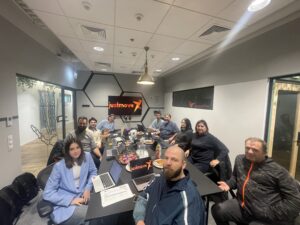
Research started on 25 September 2024. We wrote a questionnaire and each partner answered it for its own country: France, Latvia, Norway, Poland and Spain. The questions covered national laws and public programmes, the organisations active in the field, the tools youth workers use today, and how familiar young people are with the ideas of fair, local and ethical consumption.
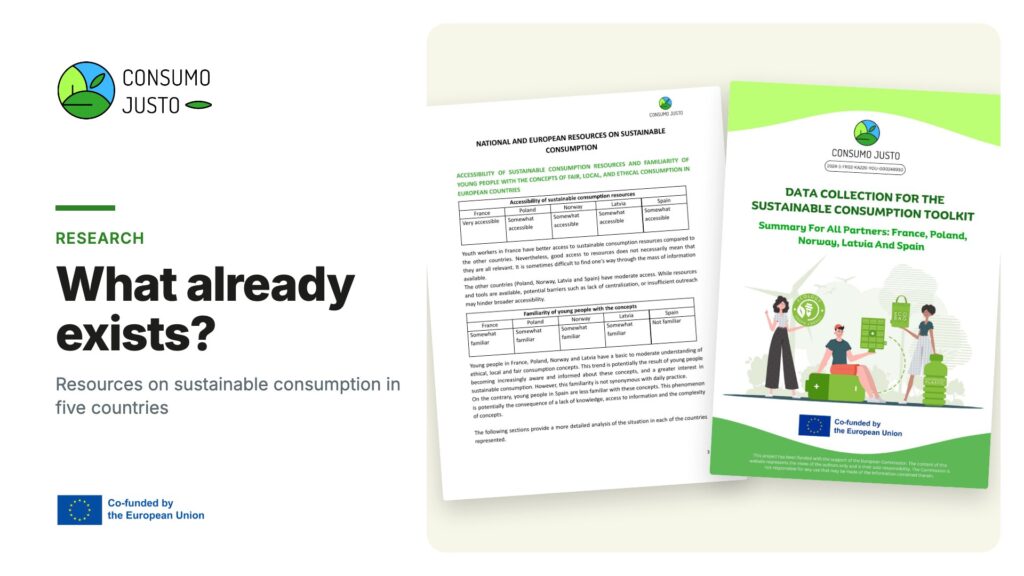
We then combined the five answers into one report, Data Collection for the Sustainable Consumption Toolkit. The English version was finished in January 2025, and the partners then translated it into their own languages. The report has 28 pages and exists in six languages: English, French, Spanish, Latvian, Norwegian and Polish.
What the comparison showed
Resources are not equally easy to find. Partners judged them “very accessible” in France and “somewhat accessible” in the other four countries, where material exists but is scattered. The report adds a warning about the French case: when there is a lot of material, it becomes hard to tell what is relevant.
Young people know the ideas better than they practise them. In four countries partners described young people as “somewhat familiar” with fair, local and ethical consumption, and in Spain as “not familiar”. The report is careful on this point and says that familiarity “is not synonymous with daily practice”.
The report also records what is already being done. In Norway, the Sustainable Eaters project gives school lessons on food waste. In Poland, Fundacja Kupuj Odpowiedzialnie runs workshops for young people on the social and environmental effects of what they buy.
The partners also agreed on one shared definition. Sustainable consumption, in the project’s words, is “the use of goods and services in a way that minimizes environmental impact, conserves natural resources, and promotes social and economic well-being”.
What young people asked for
In parallel, a questionnaire asked young people what they would want from a mobile app on this subject. It collected 94 answers, nearly all of them from the five partner countries. The largest age group was 19 to 22, and more than half of the respondents were students.
Only 19 said they were very aware of local, ethical or fair trade consumption. Another 53 were “a little aware” and 22 were not aware at all. Asked which content they wanted, they chose a map of local producers and organisations most often (60 answers), followed by tutorials (56), articles with practical advice (49), explanatory videos (47) and quizzes and games (38). About half preferred simple menus with few options.
From research to the toolkit
The report ends with guidelines for the app: short texts, content grouped by theme, several languages, ready-to-use materials for youth workers and non-formal methods such as debates and workshops. Those guidelines shaped the next steps of the project. The list of national resources became a section of the app, the definitions grew into five explanatory sheets, and the map that young people asked for is now one of the app’s four main sections.
The Consumo Justo app, with the posters, activities and resources described in these posts, is free on Google Play and the App Store.
Consumo Justo is an Erasmus+ cooperation partnership in the field of youth (project 2024-1-FR02-KA220-YOU-000248910). Five organisations run it together: Maison de l’Europe des Landes WIPSEE (France, coordinator), SETEM Navarra (Spain), Collective Innovation (Norway), Ecological Future Education (Latvia) and Mobile Adventure (Poland). All posts and results are on our Consumo Justo project page.

Funded by the European Union. Views and opinions expressed are those of the authors only and do not necessarily reflect those of the European Union or the European Education and Culture Executive Agency (EACEA). Neither the European Union nor EACEA can be held responsible for them.
#ConsumoJustoYouth #EUConsumoJusto #ConsumoJustoErasmus