
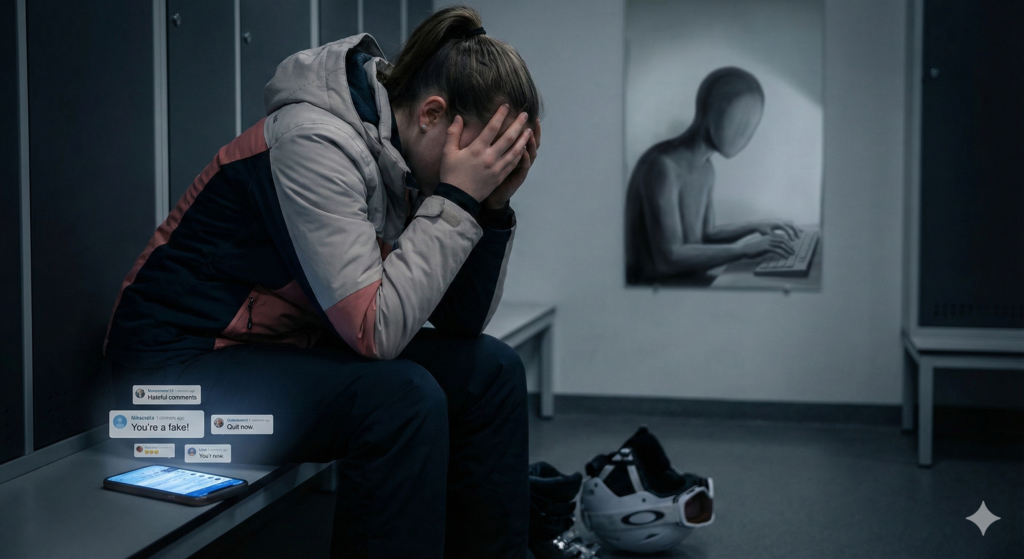
Module 3: Cyberbullying shifts the focus from technical security to psychological safety. In the hyper-connected world of modern sports, an athlete’s mental resilience is tested not just on the field, but also in the comment sections. This module uses the story of Lina, a talented 16-year-old skier, to demonstrate how quickly online abuse can derail an athlete’s career and well-being
The module deconstructs the lifecycle of a cyberbullying attack into three critical phases:
1. The Trigger: Success and Envy
The scenario begins with Lina celebrating a major victory. However, her visibility makes her a target.
- The Shift: What starts as a celebration turns toxic. Lina receives public comments like “I wish you’d get injured” and “You’re a fake hero”.
- The Escalation: The abuse moves from public comments to private Direct Messages (DMs). Fake accounts—characterized by a lack of profile pictures—begin sending personal, degrading attacks, accusing her of doping and hoping for her failure.
2. The Impact: Silent Suffering
The module emphasizes that the damage is often invisible to coaches until it is too late.
- Performance Decline: The psychological toll manifests physically. Lina withdraws from friends, loses motivation to train, and her grades drop. She suffers from insomnia, consumed by the hateful messages.
- The Breaking Point: The bullying escalates to a physical threat when a message reads: “I know your family’s address”. This crosses the line from emotional abuse to a genuine safety threat.
3. The Response: Breaking the Silence
Lina’s recovery only begins when she stops hiding. By confiding in her coach, Mr. Schiller, the team is able to intervene.
- Institutional Action: The school and club IT departments track the anonymous accounts to a fellow student. Disciplinary actions are taken, and the team implements a “Digital Respect and Safety Week”.
- Empowerment: Lina transforms her trauma into a lesson, speaking out to her peers: “Words can hurt too… No one is alone”
Educational Analysis: The Coach’s Role
This module teaches that cyberbullying is not “just drama”—it is a performance inhibitor and a safety risk. It highlights that anonymity emboldens bullies, but transparency disarms them. The module reinforces that coaches must look for behavioral changes (like withdrawal or sudden fatigue) as potential signs of digital abuse.
The “Digital Shield” Checklist for Athletes
To protect against and respond to cyberbullying, athletes should follow this “Digital Shield” protocol:
Step 1: Recognize the Signs
- [ ] Monitor the Vibe: Be aware of a shift from constructive criticism to personal attacks. “You played bad” is criticism; “You are a disgrace” is bullying.
- [ ] Spot the Fake: Be suspicious of accounts with no photos, generic names, or few followers that seem to know personal details about you.
Step 2: Do Not Engage (The Golden Rule)
- [ ] Don’t Feed the Trolls: Never reply to a bully. They want a reaction to fuel their attacks. Silence is your strongest defense.
- [ ] Mute and Block: Use the platform’s tools to block the user immediately. You do not owe them access to your life.
Step 3: Document the Evidence
- [ ] Screenshot Everything: Before blocking or reporting, take screenshots of the abusive messages, the profile page, and the timestamps. You may need this proof for school or police investigations.
Step 4: Report and Support
- [ ] Tell Someone Now: Do not wait until it gets scary. Tell a coach, parent, or counselor immediately.
- [ ] Report to the Platform: Use the “Report” button on the app to flag the content as harassment.
Step 5: Protect Your Mental Space
- [ ] Take a Break: If social media causes anxiety, delete the app for a few days. A “digital detox” can help reset your focus.
By following these steps, athletes can ensure that their digital space remains a source of motivation rather than fear.
Ready to build your team’s complete digital defense? To view all training materials please visit the official SPARTA Project Page: https://secureusparta.de/