
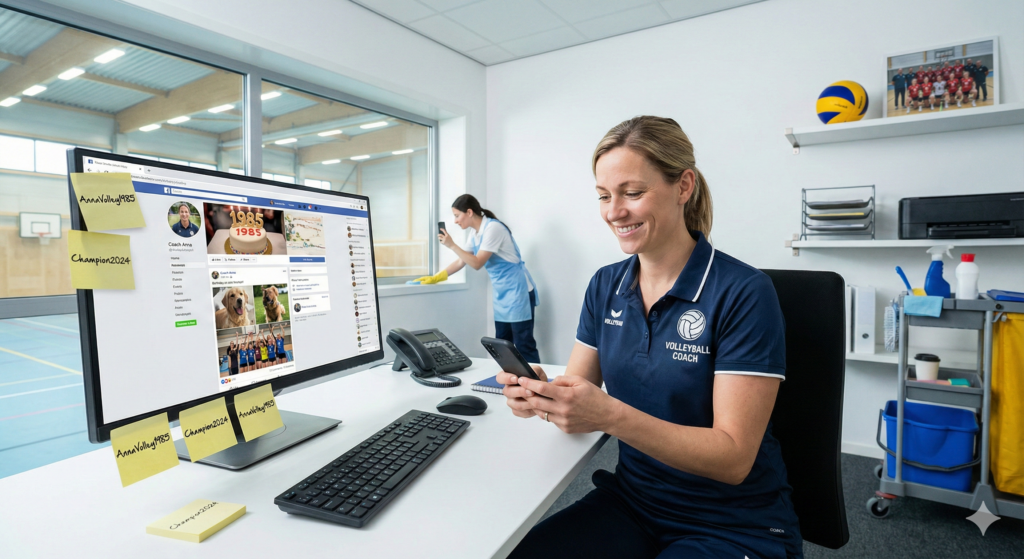
Module 2: Social Engineering expands the scope of digital resilience by focusing on a threat that blurs the line between the physical and digital worlds. While Module 1 focused on email deception, this module illustrates how attackers exploit everyday habits, human trust, and physical negligence to breach secure systems. Through the scenario of “Coach Anna,” a successful and well-loved volleyball coach, learners discover that a cyberattack often begins long before a hacker touches a keyboard—it starts with what we willingly share with the world.
The module deconstructs the attack into three distinct phases of negligence and exploitation:
1. The Vulnerability: Oversharing and Disorder
The story introduces Anna, who inadvertently creates a roadmap for attackers through two common mistakes:
- Digital Oversharing: Anna frequently posts personal details on social media, including birthday celebrations, children’s school events, and vacation plans. While seemingly innocent to her followers, these details provide the answers to common security questions and password hints.
- Physical Negligence: In her office, Anna leaves her computer screen unlocked and sticks notes containing passwords and sensitive reminders directly onto her monitor and desk.
2. The Infiltration: The “Invisible” Attacker
This module introduces a critical concept in social engineering: physical reconnaissance. The attacker does not break in through a firewall; he walks in through the front door disguised as a cleaning staff member.
- Gathering Intelligence: Because cleaners are often “invisible” to busy staff, the attacker freely observes Anna’s desk, photographing her sticky notes and unlocked screen without raising suspicion.
- Connecting the Dots: The attacker combines the physical clues (passwords on notes) with the digital clues (dates and names from social media) to easily guess her login credentials.
3. The Crisis: Exposure and Consequence
The attack culminates in a massive data breach. Using the stolen credentials, the attacker logs in remotely via VPN and steals sensitive assets, including player health records, training programs, and internal strategy documents.
- The Impact: The breach damages the club’s reputation and shakes the trust of sponsors and players alike.
- The Reality Check: Anna realizes that her “harmless” social media posts and “convenient” sticky notes were actually an open invitation to criminals.
Educational Analysis: The Convergence of Threats
Module 2 teaches a vital lesson: Security is holistic. You cannot be secure online if you are insecure offline. The attacker didn’t need advanced software to crack Anna’s password; he just needed to look at her Facebook page and the yellow sticky note on her desk. The module emphasizes that legitimate-looking personnel (like repair workers or cleaners) can be threat actors in disguise, exploiting the natural human tendency to trust uniforms
The “Clean Desk & Safe Socials” Checklist
To avoid the pitfalls that trapped Coach Anna, participants should implement this daily security checklist:
Step 1: Sanitize Your Social Media
- [ ] Audit Your Posts: Review your profile. Do you have public photos revealing your birth date, your children’s names, or your pet’s name? These are common password components—remove them.
- [ ] Blur Sensitive Backgrounds: Before posting a selfie at work, check the background. Is a whiteboard with tactics or a computer screen visible?.
Step 2: Secure Your Physical Workspace
- [ ] The “Win+L” Habit: Never leave your desk without locking your computer screen, even if you are just grabbing coffee. An unlocked screen is a wide-open door.
- [ ] Destroy the Sticky Notes: Never write passwords on physical paper. Use a digital password manager. If you must write a note, shred it immediately after use.
Step 3: Be Aware of Your Environment
- [ ] Challenge the Unfamiliar: If you see someone you don’t recognize in a sensitive area (even if they are wearing a uniform like a cleaner or technician), politely ask who they are or verify them with management.
- [ ] Clear Desk Policy: At the end of the day, clear your desk of all sensitive documents. Do not leave player files or contracts sitting out overnight.
Step 4: Strengthen Your Credentials
- [ ] Stop Using “Easy” Math: Do not use passwords based on information that can be found on your Instagram (e.g., AnnaVolley1985 or Champion2024). Attackers will try these first.
By adopting these habits, coaches ensure that their physical office is as secure as their digital accounts, closing the gaps that social engineers work so hard to find.
Ready to build your team’s complete digital defense? To view all training materials please visit the official SPARTA Project Page: https://secureusparta.de/